Fishing Gear & Rigging
Floating vs. Sinking Chum Systems: Which Should You Use?
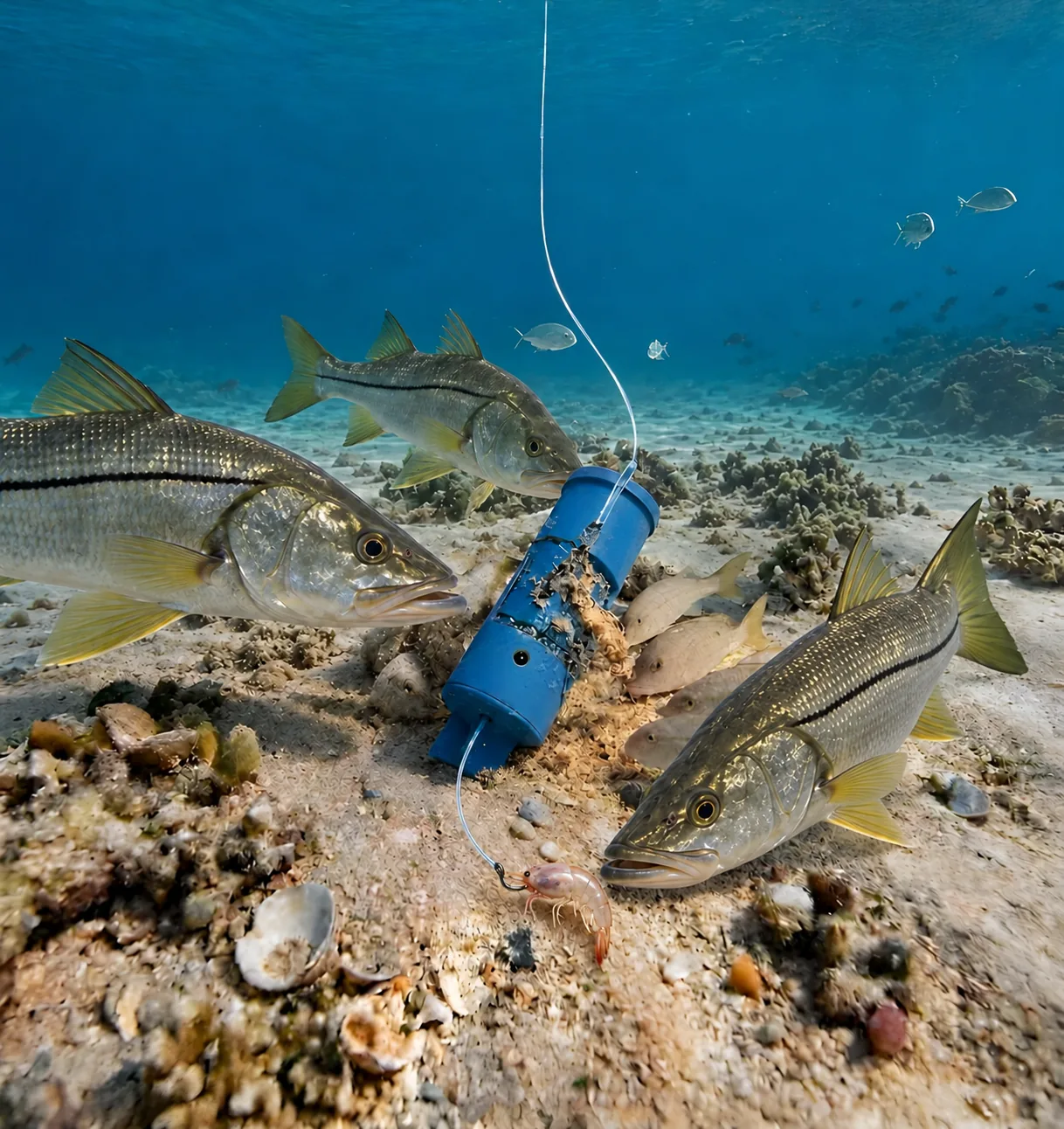
Choose a chum system by where you want material to enter the water, then account for where the water will carry it. Floating and sinking systems offer different release positions. Neither is a universal winner, and neither removes the need to check location rules or manage a safe rig.
Release depth is a starting point
Chum placement matters because a trail does not stay in a neat circle around a container. Released particles spread, drift, and sometimes settle. If the material is carried away from your hooked bait, its starting position may not support the presentation you intended. First decide where your bait is fishing and how the water moves between the release point and that area.
Surface-oriented and bottom-oriented describe release positions, not guarantees about which fish will respond. Fish can move through different depths, and conditions can change during a session. Avoid choosing on the basis of a claimed catch advantage. A sensible comparison asks what each setup lets you control and what remains dependent on water movement.
Understand a floating presentation
A floating system introduces chum from the surface. That can suit a permitted setup where you want release above a suspended bait or want to observe the container’s position. However, seeing the container does not reveal the entire trail below it. Wind may affect surface drift, and a surface current may differ from the movement of water around your hook.
The limitation is separation: material may travel sideways or disperse before reaching your intended depth. Do not assume a floating container means all the chum remains on top. Some particles sink; others stay suspended longer. Watch conditions, control your line, and avoid floating gear that drifts into boat traffic, swimmers, or other anglers’ fishing space.
Understand a sinking presentation
A sinking system delivers chum lower in the water column, which can be useful for bottom-oriented fishing setups where chumming is permitted. It reduces the distance between the initial release and the bottom, but does not eliminate downstream drift. Fine particles can still be lifted or carried away, particularly in energetic water or around structure.
Bottom-oriented equipment brings its own trade-offs: added casting load, possible snags, and more difficult observation from shore or a high pier. The seabed may be soft, rocky, or covered with weed. Use appropriate tackle, inspect the rig regularly, and do not assume a heavier load is always safer or more effective.
Factor in current and water depth
In deeper water, particles released at the surface have farther to travel before reaching the bottom. Current can move them horizontally during that descent. The same principle applies to hooked bait. The practical question is whether release and presentation overlap in a useful way, not whether a system’s name sounds right for the place you are fishing.
In shallow water, waves can mix material through much of the water column. Around pilings or a boat, flow can vary over short distances. Watch line angles and surface movement, then reassess as the tide or wind changes. If you cannot keep the rig controlled within your tackle’s limits, change your fishing plan instead of forcing the system to work.
The two Chum Buddy™ models
The Sinking Chum Buddy™ has a weight compartment that accommodates up to 4 1-ounce egg sinkers. That is a capacity limit, not an instruction to load all four every time. The Floating Chum Buddy™ has a white floating top and orange body and does not have a weight compartment. Both models are straight perforated cylindrical capsules with a keel.
Both are reusable and refillable, and both have a removable internal chum bucket. Their shared fishing uses include permitted surf or beach locations, piers, bridges, boats, freshwater, and saltwater. Do not interpret that general suitability as legal permission at every site. In particular, Florida’s beach and adjacent wade-fishing chumming restriction applies regardless of the model you select.
Use the internal bucket thoughtfully
The removable bucket gives anglers another way to configure the release openings. Its smaller openings generally slow dispersion compared with removing it and exposing the larger housing openings. Actual release depends on water movement, how tightly the material is packed, its consistency, and whether frozen contents have softened. There is no fixed release time that applies to every setup.
Both models support powdered, natural, and frozen chum; choose lawful materials and avoid blocking the openings. Follow the product’s loading and rigging guidance. After use, empty remaining chum, rinse thoroughly with fresh water, and dry before storage. Inspect parts and line for wear before the next trip rather than storing a wet, bait-filled dispenser in the tackle bag.
Beaches, piers, bridges, and boats
At a beach, legality comes first. Do not chum from a Florida beach or immediately adjacent wading waters. Where another jurisdiction permits it, consider surf, casting clearance, and whether you can retrieve the equipment safely. On a pier or bridge, check site rules, current direction, overhead obstacles, and the space shared with other anglers.
From a boat, think about the boat’s movement as well as the water’s movement. An anchored and a drifting setup can separate the dispenser and bait differently. Keep tackle clear of propellers and other lines. Follow applicable boating and wildlife rules, and do not use a surface container where it creates a navigation or swimming hazard.
When owning both may make sense
An angler who fishes different permitted locations may value having both release options rather than improvising a conversion. Chum Buddy™’s introductory individual prices are $20 for Sinking and $20 for Floating. The introductory Duo promotion is $35 for one of each, a $5 saving versus buying separately. The Duo is available to pre-order now.
Owning two models does not mean you need to use both on every trip. Choose the simplest safe setup for the conditions and your experience. Check the comparison page for model details, and make the rod’s recommended casting-weight range your boundary for the entire loaded rig. The right choice is a controlled, lawful presentation—not a promise that the fish will show up.
Sources & further reading
- Florida FWC: fish feeding and chumming rules
- Florida Sportsman: practical chumming and current considerations
Regulations can change. Verify current rules with the relevant authority for your fishing location; this guide is not a substitute for official guidance.